World Steel Industry Trends

Steel and raw material prices
The steel industry continues to be heavily influenced by the availability and pricing of raw materials – iron ore, coking coal and scrap. Since approximately 2005, demand fluctuations, particularly from China, have driven significant volatility in raw material markets, transferring substantial value between raw materials suppliers and steelmakers.
More recently, the industry has faced additional cost pressures from energy price volatility (particularly the European gas crisis of 2022–2023), supply chain disruptions following COVID-19 and geopolitical events including the Ukraine conflict which disrupted Russian and Ukrainian supplies of iron ore, coal and semi-finished steel. These factors have added unprecedented complexity to raw material procurement and cost management.
Steel's strong competitive position in its applications has generally allowed price increases to be passed on to customers after some time lag, enabling steel producers to restore or increase profitability without losing volume to alternative materials. However, the industry now faces additional cost pressures from decarbonisation requirements, with carbon pricing in Europe and mounting pressure for low-carbon production globally adding to the cost base.
The chart below illustrates the relationship between steel prices, production costs and capacity utilisation. It shows the price of hot-rolled coil (blue line, right-hand scale in US$/t), the estimated world average total cost of production for HR coil (red line, right-hand scale) and the utilisation of world crude steel capacity (green line, left-hand scale in %).
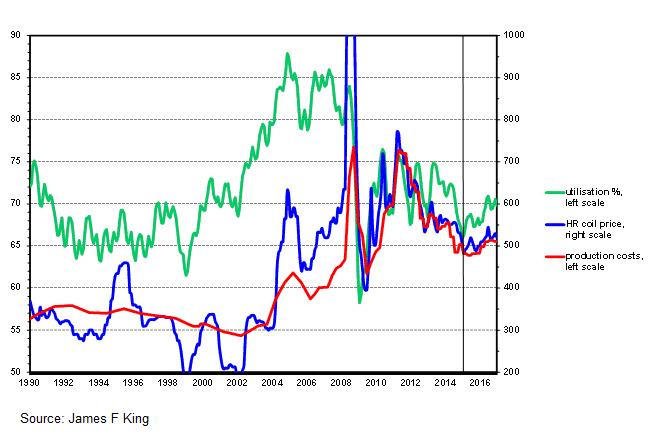
The chart demonstrates that steel prices follow production cost trends, having risen in line with costs during the high-cost period since 2005. In the short term, prices fluctuate around this trend in response to capacity utilisation levels, which are driven by changes in steel consumption.
A sustained period of high capacity utilisation from 2005 eventually caused extreme market tightness and the price spike of 2008. The severe economic downturn in 2009 brought both capacity utilisation and prices down sharply. From 2012 to 2020, prices moved closely in line with average production costs.
The COVID-19 pandemic in 2020 caused a sharp but brief downturn, followed by a strong recovery in 2021 with capacity utilisation reaching very high levels. This led to another price spike in 2022, though not as extreme as 2008. The 2022 spike was exacerbated by the Ukraine conflict which disrupted Russian coal and steel exports, and the European energy crisis which forced temporary shutdowns of energy-intensive steel plants.
Since then, capacity utilisation has declined from peak levels, particularly affected by weaker demand in China as the country deliberately reduces steel production capacity and shifts away from construction-led economic growth. China's environmental policies and "dual control" measures limiting energy consumption have also contributed to lower production levels.
Production costs have become more variable over the short term as raw material pricing shifted from annual to quarterly or shorter cycles, with spot market conditions exerting greater influence. This increased volatility in input costs has made price forecasting more challenging for both producers and consumers.
Energy costs have emerged as an increasingly critical component, particularly in Europe where natural gas prices spiked dramatically in 2022–2023. Additionally, carbon pricing mechanisms (such as the EU Emissions Trading System) and the impending Carbon Border Adjustment Mechanism (CBAM) are adding new cost pressures that will reshape global steel trade patterns and production economics.
Current Market Conditions (September 2025)
Latest Market Snapshot – September 2025:
| Indicator | Current Value | 12-Month Change | Direction |
|---|---|---|---|
| Iron Ore (62% Fe CFR China) | US$104/t | +1.9% | Static |
| Coking Coal (FOB Australia) | US$163/t | -7.9% | Rising slowly |
| Steel Scrap (Europe HMS 1/2) | US$296/t | -11.5% | Falling |
| HR Coil (Europe Export) | US$598/t | +2.1% | Rising |
| Crude Oil (Brent) | US$67.50/barrel | -10.0% | Rising slowly |
Data as of September 2025.
Production Costs and Profitability
Analysis of HR coil production costs for September 2025 reveals the cost structure facing the average global producer:
| Cost Element | US$/t | % of Operating Costs |
|---|---|---|
| Iron ore | US$130 | 23.9% |
| Coal and coke | US$124 | 22.8% |
| Scrap, pig iron & DRI | US$79 | 14.5% |
| Purchased semis and coil | US$12 | 2.3% |
| Other operating costs | US$200 | 36.6% |
| Total operating costs | US$546 | 100.0% |
| Capital charges | US$91 | 16.6% |
| Total costs | US$637 | 116.6% |
| Target profit | US$53 | 9.8% |
| Total costs + target profit | US$690 | 126.4% |
With the international HR coil price at approximately US$478 per tonne in September 2025, the average producer was operating at a loss of US$68 per tonne on operating costs (EBITDA margin of -14.3%) and US$159 per tonne on total costs (EBT margin of -33.3%). The price needs to be US$212 per tonne higher to permit normal profitability, indicating continued industry stress.
Steel Demand Trends
World crude steel production trends from August 2025 (annualised rates):
| Region | Production (Mt/yr) | Year-on-Year Change | Trend |
|---|---|---|---|
| World Total | 1,838 | +0.3% | Falling slowly |
| China | 936 | -0.7% | Falling |
| World ex-China | 902 | +1.4% | Rising slowly |
| USA | 87 | +3.1% | Rising |
| Brazil | 36 | -4.3% | Rising |
| Europe | 178 | -1.6% | Rising |
| India | 166 | +13.2% | Rising slowly |
| Japan | 83 | -3.2% | Now falling |
World crude steel consumption is forecast at 1,885 million tonnes for 2025 (+0.4% growth) and 1,966 million tonnes for 2026 (+4.0% growth). Production growth is expected to be +0.2% in 2025 and +4.1% in 2026. The expected recovery in consumption and production was steadily pushed back through 2024 as weak demand conditions persisted, particularly in China.
Regional dynamics are shifting significantly. The USA has benefited from infrastructure investment and trade protection measures, including Section 232 tariffs maintaining steel prices at elevated levels. India has emerged as a major growth market and is positioning itself as a future steel powerhouse with substantial capacity expansions planned. Europe faces structural challenges from high energy costs, strict environmental regulations and competition from imports, whilst also leading the transition to low-carbon steel production.
China's steel demand has been weakened by the property sector crisis and government policies to reduce construction activity and overcapacity. However, China remains by far the world's largest producer and its production decisions continue to determine global steel prices and trade flows.
Raw Material Price Outlook
Iron Ore: The benchmark price for 62% Fe sinter fines (CFR Qingdao, China) averaged US$109.42 in 2024, with forecasts of US$100.23 for 2025 and US$93.17 for 2026. Large iron ore resources remain potentially available in Australia, Brazil and new developments in West Africa, though infrastructure costs for new projects remain high.
Several factors will affect future iron ore development:
- The high capital cost of infrastructure (railways, ports and towns) to open resources in remote areas gives substantial cost advantages to existing producers who can make incremental additions to existing infrastructure
- Dwindling resources of the highest grades mean natural high-grade products (blast furnace and DR-grade lump ore) will become increasingly scarce, forcing consumers to switch to more processed products (sinter or pellets)
- Gradual shift from natural high-grade haematite ores to magnetite ores with lower natural iron content requiring concentration or pelletising. Whilst magnetite resources are vast, production costs are substantially higher
- Further decline in iron ore quality in major producing areas already using magnetite ores (China, CIS, USA). Iron ore grades at Chinese mines average below 20% Fe content, requiring massive energy-intensive processing. Costs will increase and much capacity may close for cost or environmental reasons
Coking Coal: Hard coking coal (FOB Australia) averaged US$253.28 in 2024, with forecasts of US$191.33 for 2025 and US$195.36 for 2026. The market has been affected by political disputes, including restricted Australian coal access to China from late 2020, leading to supply chain disruptions. Australia has not yet regained its Chinese market share. The Ukraine conflict also disrupted Russian coal exports to Europe, forcing European buyers to source from more expensive alternatives.
Coking coal is the raw material with the most significant resource constraints. Deposits of high-grade coking coal are limited and capital, operating and transport costs are high. This will maintain relatively high prices, driving:
- Increased use of pulverised coal injection (PCI) on all new blast furnaces and retrofitting of existing furnaces to reduce coke consumption
- Acceleration of electric arc furnace (EAF) steelmaking in place of integrated steel production, particularly as scrap availability increases and decarbonisation pressures mount
- Development of alternative ironmaking technologies including direct reduced iron (DRI) using natural gas or hydrogen, eliminating coking coal requirements entirely
Steel Scrap: The benchmark scrap price (75% HMS1, 25% HMS2, FOB Rotterdam) averaged US$344 in 2024, with forecasts of US$317 for 2025 and US$386 for 2026. Scrap prices tend to follow steel prices, as the costs of iron ore and coal determine integrated producers' costs and therefore set the baseline against which scrap-based producers must compete.
The wide gap between scrap prices and collection/processing costs suggests potential for vertical integration by steelmakers. However, those at the bottom of the scrap supply chain know market values, limiting the benefits of integration. Scrap companies must also handle other metals (aluminium, copper, etc.) that come with collected steel scrap.
Nevertheless, there has been a trend for steel companies to establish or grow their own scrap operations by acquiring larger independent scrap companies. Independent scrap companies are also consolidating into larger enterprises because of increasing costs of compliance with environmental and financial regulations that make it difficult for small companies.
Key scrap market dynamics:
- Extensive international trade, with main flows from USA and northern Europe to southern Europe and the Far East. However, trade patterns have been disrupted by high shipping costs and regional self-sufficiency policies
- China's relatively small scrap-based production (electric steel sector) is expected to grow significantly as the country's steel stock matures and domestic scrap availability increases. This could substantially reduce Chinese demand for iron ore whilst potentially disrupting international scrap markets
- Some countries regard scrap as a domestic resource and may ban exports when markets tighten, making long-distance scrap transport a risky strategy. Several countries have implemented or considered such restrictions in recent years
- Consolidation of independent scrap companies into larger enterprises due to increasing compliance costs with environmental and financial regulations
- Growing recognition of scrap as a strategic resource for decarbonisation, as EAF steelmaking using scrap produces approximately 75% less CO₂ than traditional blast furnace routes
Strategic Responses to Raw Material Costs
The steel industry's response to high raw material prices from 2005 onwards has been threefold:
- Capacity investment: Increased investment in new iron ore and coal capacity by both existing producers and new entrants. This investment resulted in substantial new capacity starting production from 2012 onwards, with continued additions for several years thereafter
- Vertical integration: Steelmakers acquiring their own raw materials, reversing a trend from the late 1970s onwards where European and North American steelmakers progressively closed or sold their iron and coal operations. Western producers (particularly ArcelorMittal and Tata) and many Chinese producers have moved rapidly to acquire iron ore and coking coal operations or projects. This has changed market structure, reducing third-party sales as new competitors start operations
- New supply sources: Steel consumers in China sought new sources from countries with previously small iron ore industries. Large quantities of iron ore have been imported into China from Malaysia, Indonesia, Vietnam and Mongolia. Chinese capital and enterprise has expanded supply from these less conventional sources
From 2014, these actions resulted in lower prices for traded iron ore and coking coal. This has reduced the cost advantage of captive production, though companies with captive supply retain substantial advantages. Access to captive iron ore and coal remains a major strategic advantage for producers already in that position or able to achieve it at reasonable investment cost.
Future Outlook
Our view is that the established pattern will continue: steel prices will follow the underlying level of production costs, which depend on physical availability of iron ore and coal resources and long-term trends in energy, labour and capital equipment costs. Prices will fluctuate widely around this trend in response to short-term changes in steel consumption and resulting capacity utilisation.
However, the industry faces unprecedented transformation driven by decarbonisation requirements. The shift away from coal-based steelmaking towards hydrogen-based direct reduction and electric arc furnaces will fundamentally alter raw material demand patterns over the next two decades. This transition will require massive investment – potentially over US$1 trillion globally – in new production facilities and associated hydrogen infrastructure.
Of the two main materials, coking coal faces the most significant resource constraints, likely meaning continued relatively high prices and driving efforts to reduce coke consumption. However, coal demand for steelmaking may peak within the next decade as new low-carbon technologies are deployed at scale.
Iron ore has large resources available, but future costs will be affected by:
- High infrastructure capital costs in remote areas
- Declining ore grades requiring more processing
- Shift from natural high-grade haematite to magnetite requiring concentration
- Potential closure of high-cost, low-grade operations in China for economic or environmental reasons
- Growing demand for high-grade ores and pellets suitable for direct reduction processes, which may command premium prices
Steel scrap will become increasingly valuable as EAF production expands globally. The transition to scrap-based production is already well advanced in regions with mature steel stocks (USA, Europe) and will accelerate in developing economies as their steel stocks mature. Competition for quality scrap will intensify, potentially supporting higher scrap prices relative to iron ore.
Trade policy and regional self-sufficiency drives will continue to fragment global steel markets. The USA's Section 232 tariffs, Europe's Carbon Border Adjustment Mechanism and various other trade measures mean steel and raw material flows will be increasingly determined by policy rather than pure economics. This adds another layer of complexity to supply chain management and investment decisions.
The steel industry will continue to balance these cost pressures through technology improvements, vertical integration strategies and careful capacity management to maintain profitability through inevitable market cycles. However, the scale and speed of the required transformation to low-carbon production represents the industry's greatest challenge since its industrialisation in the 19th century.
Need this analysis for your own plant or market? Our Strategy Support Service → Discuss a Project →