From Market to Business Strategy
From Diagnosis to Action
Our strategy support service helps steel producers understand their competitive position and identify the actions most likely to improve long-term profitability. The process moves through two distinct stages: first, a rigorous diagnosis of where SteelCo stands – on the cost curve and in its markets; then a structured review of the adaptation options available to address the challenges identified.
Drawing on our proprietary cost models, market data and more than 30 years of steel industry advisory experience, we provide a clear, evidence-based picture of SteelCo's current position and the most promising routes forward.
Our Approach
Steel strategy rests on a simple but demanding logic: you cannot choose the right course of action until you have an honest picture of where you stand. Diagnosis comes first; adaptation follows from it.
Diagnosis
We establish an evidence-based picture of SteelCo's competitive position across two dimensions: cost position relative to peers on the cost curve, and market attractiveness – the structural characteristics of the markets SteelCo serves.
Together these define the strategic challenge and set the parameters for what adaptation is possible.
Adaptation
With the diagnosis established, we review the full range of strategic options available to SteelCo – covering cost and efficiency improvement, technology and process change, product and market development, and structural repositioning.
Options are evaluated for feasibility, risk and financial impact, drawing on our financial analysis capabilities where required.
Stage 1 Diagnosis
Cost Position
Benchmarking SteelCo Against the Competition
Cost competitiveness is a prerequisite for sustained profitability. A producer sitting in the upper half of the cost curve is vulnerable in any period of price weakness. A low-cost producer has both a structural profitability advantage and a degree of protection in downturns.
Our cost benchmarking process uses detailed cost models to build a picture of SteelCo's cost per tonne across all key cost elements – raw materials, energy, labour, consumables and fixed overhead. We then position this against comparable cost estimates for peer producers in the same or competing markets.
The result is a cost curve showing clearly where SteelCo sits relative to its competitors – and forming the basis for targeted cost reduction recommendations. Our full approach is described in the cost benchmarking methodology.
Market Attractiveness
Even a low-cost producer can struggle to generate acceptable returns if it serves an inherently unattractive market. Our market attractiveness assessment draws on the findings of the market appraisal to evaluate four key dimensions:
Industry Structure
How many producers serve the market? A fragmented market – such as rebar in Spain or Poland with seven or eight suppliers – means producers compete primarily on price. A monopoly or near-monopoly structure is typically far more profitable. Understanding where SteelCo sits on this spectrum is fundamental to any strategic assessment.
Industry Growth
Is the target market growing or in structural decline? A growing market supports volume expansion and eases competitive pressure. A declining market forces producers to fight for share in a shrinking pool of demand, compressing margins and increasing business risk.
Domestic Market Size
Is the domestic market large enough to absorb SteelCo's output at acceptable utilisation levels? If not, the business will be forced to export. All other things being equal, export sales are considerably less profitable than domestic sales – due to transport costs, tariffs, currency risk and reduced pricing power.
Export Potential
Where domestic market size is limiting, are there neighbouring or regional export markets SteelCo could exploit? Proximity, logistics costs, trade agreements and competitive dynamics in those markets all determine whether export is a viable supplement – or an uneconomic necessity.
Stage 2 Adaptation
Once the diagnosis is established, the strategy question becomes: what should SteelCo do about it? We review the full range of adaptation options, structured across four broad categories:
Adaptation options
Cost & Efficiency Improvement
- Decarbonisation: Switch from BOF to EAF; implement BAT for cost savings.
- Profit improvement programmes: Systematic review of cost drivers and operational performance. See our podcast on profit improvement programmes.
- Purchasing practices: Multi-sourcing of raw materials and consumables may offer material cost benefits.
- Information systems: Do management systems accurately measure production costs and KPIs, giving leadership the quality information needed to act?
Technology & Process Change
- Radical process innovation: New technology can transform the cost base. Endless casting and rolling – as deployed in MiDa-type operations – can cut conversion costs substantially. See our technology trends page.
- Product switching: Technology investment can enable a move to higher-value product categories – for example, from rebar to light sections.
Product & Market Development
- Product differentiation: Adding a different coating or specification – for example AlZn instead of standard zinc – can create a price premium and customer stickiness.
- Move from commodity to specialty: Shifting from low-cost commodity products (e.g. fencing wire) to higher-quality specialty grades (e.g. drawing wire for strand) reduces import exposure and moves SteelCo up the value chain.
- Market niche: Finding a structural monopoly through specific grades or sizes where competition is limited. Monopoly positioning often brings high financial returns.
- Capacity utilisation: Selling existing products into new markets improves utilisation and reduces unit costs. See EBITDA dependence on capacity utilisation.
Structural Repositioning
- Vertical integration: Integration into scrap collection or downstream into distribution can improve margin capture and reduce cost volatility.
- Market niche: Find a structural monopoly – specific grades, sizes or geographies where competition is limited and pricing power is higher.
Strategic Planning Tool: The Ansoff Matrix
A particularly useful framework for product and market development decisions is the Ansoff Product-Market Matrix. It structures strategic options around combinations of existing and new products versus existing and new customers – helping to clarify risk, resource requirements and likely returns for each path.
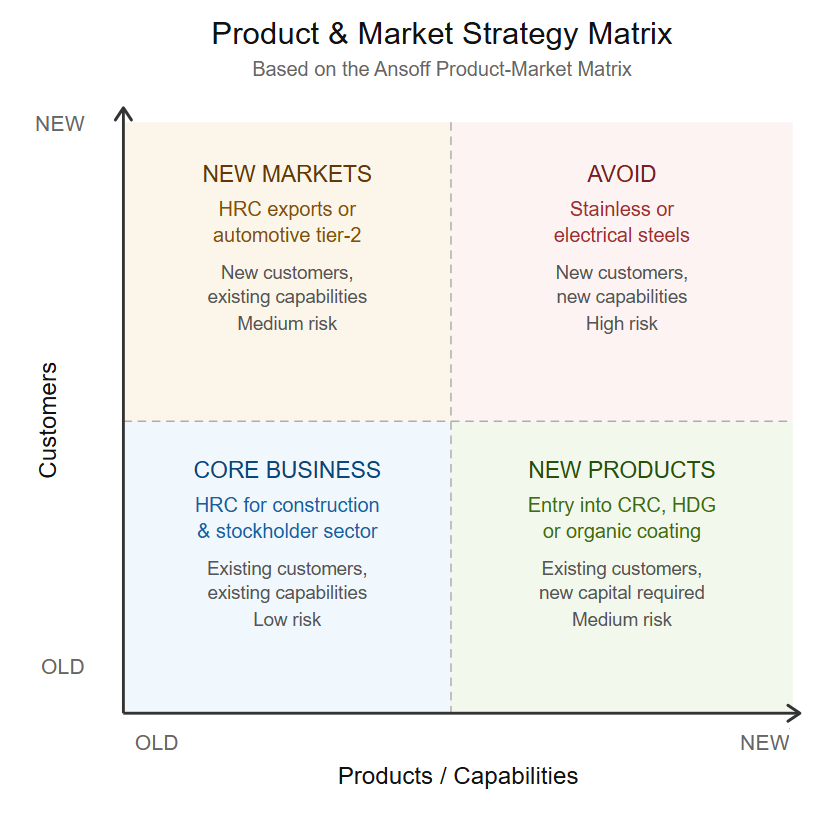
Core Business (existing products, existing customers) is lowest risk but most exposed to commoditisation and import competition.
New Markets (existing capabilities, new customers – e.g. HRC exports or automotive tier-2) offers medium risk and leverages existing strengths.
New Products (e.g. entry into CRC, HDG or organic coating) requires new capital but serves existing customers with greater breadth.
Avoid (new products for new customers) carries the highest risk and is generally to be avoided unless the strategic logic and capability gap are both well understood.
How the Strategy Support Service Works
An Integrated, Evidence-Based Process
Our strategy support is not a generic framework exercise. It is grounded in specific data – costs, markets, competitive landscape – that only rigorous analysis can provide. The strategy engagement typically draws on, or is conducted alongside, our other advisory services:
- The market appraisal provides the market attractiveness inputs – demand, competitors, pricing and structure.
- The technical review establishes the operational baseline – what the plant can do, and where technical limitations constrain options.
- The financial analysis quantifies the EBITDA and return implications of each strategic option under consideration.
For a fully integrated assessment combining all four elements, see our feasibility study service.
What the Strategy Report Covers
- Cost position: SteelCo benchmarked on the cost curve versus peers
- Market attractiveness assessment across structure, growth, size and export potential
- Review of relevant adaptation options across all four categories
- Ansoff Matrix product/market development analysis where applicable
- Prioritised strategic recommendations with supporting rationale
- Financial implications of recommended options, linked to the financial analysis
Reports are prepared to the agreed scope, schedule and budget. All client materials are handled under our strict data security framework.
Need a Clear Strategy for Your Steel Business?
152 projects in 48 countries since 2001
Free, confidential first conversation No obligation Reply within one working day
Related Services
Strategy support sits alongside our four other core advisory services, and is most powerful when informed by their outputs:
Related advisory services
For a fully integrated feasibility study – combining market, technical, financial and strategic analysis – see our feasibility study service.