Dual Barriers & Market Failure
Executive Summary
The global steel industry faces a mounting crisis: surplus steelmaking capacity is projected to surge to 721 million tonnes by 2027, pushing capacity utilisation rates down from 78–79% to approximately 70% and triggering a profitability crisis that threatens even the strongest producers¹.
This isn't a cyclical downturn that market forces will naturally correct. The steel industry's unique structural characteristics – particularly formidable barriers to both market entry and exit – create what economists term a "capacity trap" where rational economic adjustments fail to occur. State intervention systematically undermines natural entry barriers by subsidising uneconomic capacity additions, whilst formidable exit barriers trap capital in the industry. Environmental remediation obligations alone exceed £400m for large integrated facilities, whilst worker severance obligations add £160,000–400,000 per employee.
Breaking this trap requires government intervention addressing both dimensions: raising entry barriers to prevent further uneconomic capacity whilst lowering exit barriers to facilitate closure of existing surplus facilities. The German coal phase-out – which deployed €40bn to achieve a 70% capacity reduction – provides a proven template. For the EU steel sector, achieving a 50-million-tonne capacity reduction would require approximately £60–80bn over 10–15 years.
The Dual Barrier Problem
The steel sector's overcapacity stems from simultaneously high barriers to both entry and exit – a dual barrier structure that perpetuates excess capacity even during extended periods of poor profitability.
Entry Barriers That Fail to Protect
Despite chronic overcapacity, steel maintains formidable entry barriers. Capital requirements for greenfield integrated plants range from £800–1,200 per tonne of annual capacity, translating to £2.4–3.6bn for a 3-million-tonne facility. Combined with 15–25-year payback periods and technical complexity requiring decades of accumulated knowledge, these create obstacles that only the largest corporations or state-backed entities can overcome.
Yet global capacity continues expanding through government intervention that systematically undermines market-based constraints. Governments – particularly in emerging economies – view steel production as strategically important, providing subsidised financing, energy cost support, trade protection and environmental forbearance that make otherwise uneconomic projects viable.
China exemplifies this dynamic.
- Despite official capacity restraint policies, Chinese steelmaking capacity expanded by over 150 million tonnes between 2015 and 2024.
- State-owned enterprises benefit from preferential capital access at below-market rates, artificially low energy costs and relaxed environmental enforcement that reduces operating expenses by 15–25% compared to commercially-operated facilities.
- Similar patterns emerge across India, Vietnam, Indonesia and Middle Eastern countries.
This state-sponsored entry systematically undermines natural barriers, resulting in persistent overcapacity that depresses global profitability.
Exit Barriers: The Capital Trap
Whilst state intervention undermines entry barriers, exit barriers remain formidably high, trapping capital even during extended unprofitability. Four interconnected factors create this trap:
Asset specificity creates the most fundamental barrier. Steel production equipment serves no alternative industrial purpose. For a £3bn facility, this means losing £2.85bn in stranded capital.
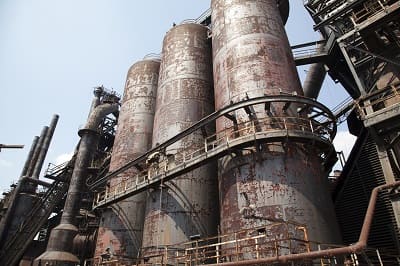
Environmental remediation obligations compound financial barriers. Closing facilities triggers substantial decommissioning costs including soil contamination cleanup, groundwater restoration, hazardous material removal and structural demolition – frequently exceeding £400m for large integrated facilities.
Employment obligations create additional constraints.
- Steel facilities commonly employ 3,000–10,000 workers directly, representing the largest employer in regional markets.
- Plant closure triggers catastrophic regional disruption, generating intense political pressure against exit.
- Collective bargaining agreements require substantial severance payments, pension top-ups and healthcare continuation – totalling £160,000–400,000 per employee.
Strategic considerations further reinforce barriers. Companies fear that closing facilities cedes market share to competitors that may prove impossible to recapture if conditions improve. Additionally, integrated producers find that closing one facility creates operational inefficiencies across their entire production network.
The cumulative effect creates powerful lock-in. A company considering closure faces: £2.85bn in stranded capital, £400m in environmental remediation, £800m–2bn in worker obligations and strategic market share concerns. Against this £4–5bn exit cost, continuing to operate at a £50–100m annual loss appears rational – the facility would need to lose money for 40–80 years before exit becomes financially preferable.
Breaking the Trap: Strategic Policy Framework
Effective intervention must address both sides of the barrier equation simultaneously. Four interventions offer the highest leverage: strategic ownership screening, environmental permitting complexity, carbon border adjustments and comprehensive state-backed closure programmes.
Ownership Screening: Preventing Inappropriate Acquisitions
A particularly insidious form of state-sponsored market failure occurs when governments permit inappropriate ownership changes of distressed steel assets. Repeatedly across global markets, authorities allow acquisitions by purchasers lacking adequate financial capacity, relevant operational expertise or genuine long-term commitment to the sector.
The pattern is familiar: a struggling steel facility enters financial distress, creating urgency for government action to preserve employment. Opportunistic purchasers emerge – often from unrelated industries or with questionable track records – offering to "save" the operation. Governments, desperate to avoid closure announcements, approve these transactions with minimal due diligence. The result: assets pass to owners unable to fund necessary capital expenditure or sustain operations through market cycles, leading to renewed crises within 18–36 months.
This dynamic actively worsens overcapacity problems. Inappropriate owners prolong the existence of uneconomic capacity that should exit the market, consuming government support whilst failing to achieve genuine operational improvement. When these ventures inevitably collapse, the facility returns to distress under worse conditions – more depleted capital equipment, deeper financial obligations and a demoralised workforce.
Strategic ownership screening offers a powerful preventative intervention. Governments should establish mandatory assessment frameworks evaluating: balance sheet strength demonstrating capacity to fund three-to-five year working capital requirements plus major capital expenditure; relevant operational expertise through evidence of successful steel sector management or demonstrable technical partnerships; credible business plans detailing specific operational improvements, market positioning and financial projections with independent validation; and binding investment commitments establishing minimum capital expenditure levels, employment maintenance periods and pension obligation funding.
Screening mechanisms would separate short-term opportunists from genuine long-term operators. Companies unable to meet threshold requirements would be barred from acquisition.
Implementation requires political courage to reject inadequate acquisition proposals despite employment preservation pressures. However, the alternative – allowing inappropriate ownership changes that merely postpone inevitable closures whilst consuming additional public resources – represents worse economic and social outcomes. Strategic screening concentrates scarce steel assets in the hands of operators capable of genuine long-term viability, whilst facilitating orderly closure of capacity better served by managed wind-down than failed rescue attempts.
Environmental Permitting: The Highest-Leverage Entry Barrier
Environmental permitting represents perhaps the single most powerful tool for raising entry barriers, combining effectiveness with legitimacy. Policymakers directly control permitting processes, timelines and performance standards – unlike trade measures vulnerable to WTO challenge.
Strategic enhancement could extend mandatory environmental impact assessments from 12–18 months to 24–36 months with expanded scope, add multi-stage public consultation processes and establish cumulative emissions thresholds creating absolute caps on expansion. Most powerfully, new EU facilities could be required to demonstrate carbon intensity below 0.5 tonnes CO₂ per tonne steel, zero-discharge water systems and strict air quality compliance. These technology-forcing standards would add 30–40% to capital costs whilst maintaining legitimacy as environmental protection.
Carbon Border Adjustment: Addressing the Root Cause
Carbon border adjustment mechanisms offer structural reinforcement addressing a fundamental source of state-sponsored competitive advantage. The EU's CBAM, phasing in from 2026, will impose costs of €60–100 per tonne on steel imports from regions with weak climate policies – effectively a 10–15% tariff.
This approach possesses unique strategic value because it simultaneously raises entry barriers whilst creating pressure to improve existing operations. Unlike traditional tariffs that simply redirect trade flows, carbon border adjustments change the underlying economics of production location decisions. Studies suggest comprehensive carbon pricing could reduce economically viable global steel capacity by 80–120 million tonnes by eliminating production dependent on environmental cost externalisation².
The strategic beauty of CBAM lies in its legitimacy and sustainability. Unlike conventional trade barriers that invite retaliation, carbon border adjustments enjoy strong legal foundations as climate policy measures and create incentives for foreign producers to reduce emissions.
Comprehensive Closure Programmes: The Exit Barrier Solution
On the exit side, comprehensive state-backed closure programmes offer the most direct path to capacity reduction. The German coal phase-out demonstrates that properly-designed programmes can overcome even the most formidable exit barriers.
The programme structure combines three elements: direct financial compensation covering asset write-downs, environmental remediation funding with government assumption of decommissioning costs and comprehensive worker transition support including extended income support, intensive retraining, early retirement bridges and relocation assistance.
Critical innovations include three design features. First, sunset clauses⁴ establish definitive closure timelines with declining support over time, creating incentives for early voluntary participation. The German coal model established 2038 as the final closure deadline with subsidy levels declining 10% every two years. Second, verified destruction requirements ensure genuine capacity retirement through physical dismantling of core equipment with independent verification. Third, regional development funding addresses concentrated employment impacts. The German approach allocated €30.65bn to affected regions – seven times the direct company compensation – recognising that sustainable transitions require building replacement economic bases.
For steel, a typical large integrated facility would receive: £2.4bn in stranded asset compensation, £400m in environmental remediation, £800m in worker transition support, totalling £3.6bn for permanent, verified capacity retirement. The programme's effectiveness depends on adequate funding and sustained political commitment – exchanging long-term subsidisation for one-time transition support that permanently resolves overcapacity.
Evidence from Coal: European Restructuring Success
The European coal industry's managed decline offers compelling evidence of comprehensive restructuring's effectiveness. Between 1990 and 2020, European coal production fell by over 70% through programmes combining closure subsidies, worker transition support and regional development.
The German coal phase-out provided €40bn in support split between company compensation (€4.35bn), worker transition and pension payments (€5bn), and regional economic diversification (€30.65bn)³. The programme achieved complete hard coal mining phase-out by 2018 and will eliminate lignite production by 2038.
Critical success principles included definitive timelines creating certainty for stakeholders, comprehensive worker support averaging €250,000 per worker addressing social barriers to exit and regional diversification funding building replacement economic bases. Results demonstrate effectiveness: German coal mining regions achieved unemployment rates within 2–3 percentage points of national averages within 5–7 years post-closure, whilst new business formation rates exceeded national averages by 2020.
However, steel presents distinctive challenges. Competitive international markets create different dynamics – European closures may simply shift market share to state-subsidised producers elsewhere. This necessitates combining capacity reduction with entry barriers to prevent market share transfer to inefficient producers.
Implementation Requirements
For the EU steel sector, achieving a 50-million-tonne capacity reduction would require approximately £60–80bn over 10–15 years – substantial but manageable within EU structural fund frameworks. This encompasses direct closure compensation (£30–40bn), environmental remediation (£15–25bn), worker transition support (£8–12.5bn), with the balance supporting regional diversification.
Critical success factors include sustained political commitment spanning 15–25-year timeframes and multiple electoral cycles, strategic selectivity distinguishing facilities meriting transformation support from closure candidates, rigorous subsidy conditionality ensuring genuine capacity retirement through verified equipment destruction, just transition principles prioritising worker welfare to maintain political legitimacy and coordination with trade policy preventing market share transfer to inefficient producers.
Conclusion: Breaking the Vicious Cycle
The global steel industry's overcapacity crisis reflects fundamental market failure rooted in the sector's unique dual barrier structure. State intervention systematically undermines natural entry barriers, enabling uneconomic capacity additions, whilst formidable exit barriers trap capital even during extended unprofitability. This creates a vicious cycle: overcapacity drives unprofitability, triggering political pressure for government support, which often takes the form of production subsidies that further entrench overcapacity.
Breaking this cycle requires governments to fundamentally reorient steel policy away from short-term production protection toward long-term capacity management. This means accepting that some capacity must close permanently, providing financial and social support to make closure politically acceptable, whilst simultaneously restricting new uneconomic capacity through environmental permitting, carbon border adjustments and international coordination.
The European coal industry's managed decline demonstrates that comprehensive restructuring can achieve substantial capacity reduction whilst protecting workers and communities. The German approach – combining €40bn in support with sunset clauses, comprehensive worker protection and regional diversification – provides a proven template. The key innovations translate directly: definitive timelines preventing perpetual subsidisation, generous worker support maintaining political acceptability, regional development funding building replacement economies and verified destruction ensuring genuine capacity retirement.
The financial requirements – £60–80bn for a 50 million tonne EU capacity reduction – represent substantial but manageable commitments. The alternative – extended unprofitability at 70% capacity utilisation – imposes far greater long-term costs through sustained capital misallocation, delayed decarbonisation and protracted trade tensions.
Without decisive intervention, the steel industry faces decades of unprofitability generating continuous political pressure for government support. The perverse reality is that ad hoc support measures typically reinforce the underlying problem rather than resolving it – protecting production rather than facilitating adjustment, subsidising operations rather than funding transition, maintaining overcapacity rather than enabling reduction. Breaking this pattern requires a fundamental shift from defensive protection to strategic restructuring.
The policy tools for breaking the overcapacity trap are well understood from coal restructuring experience. The question is whether political will exists to deploy them at the scale and sustained commitment required for success. Early movers gain advantages – capacity reduction implemented before competitors creates immediate profitability improvements, whilst delay means restructuring under deteriorating conditions. The window for strategic restructuring is narrowing as overcapacity intensifies and financial performance weakens. The future competitiveness of the global steel industry depends on whether governments intervene strategically – facilitating genuine capacity reduction through comprehensive support for closure and transition – or perpetuate the problem through defensive measures that protect the status quo.
SteelOnTheNet
7 November 2025

Facing this on a live project? Our Market Appraisal Service → Discuss a Project →
How to Cite This Article
Kotas, A.M. (2025) 'The Overcapacity Trap: Barriers to Entry and Exit in Steel', SteelOnTheNet. Available at: https://doi.org/10.5281/zenodo.18924617 (Accessed: 26 October 2026).
Author credentials:  ORCID iD