Steel as a 'Strategic Material'
Executive Summary
The designation of steel as a "strategic material" has become contentious in trade policy, with profound implications for tariffs, subsidies and industrial strategy. Analysis of steel products by defence criticality, supply concentration and substitutability reveals that approximately 1% of global steel production genuinely warrants strategic designation based on objective criteria. The remaining 99% trades in deep, competitive global markets with multiple suppliers and reasonable substitutes.
Products with genuine strategic importance include armour plate for naval vessels and military vehicles, nuclear-grade forgings for reactor pressure vessels and premium seamless tube for defence applications. These products – totalling perhaps a few million tonnes annually from a global production base of 1,742 million tonnes (2024) – share common characteristics: supply concentration amongst fewer than 10 global producers, essential defence or critical infrastructure applications and limited substitutability1.
A defining pattern emerges: genuinely strategic steel products are predominantly alloy steels requiring specialised metallurgical capabilities (nickel-chromium-molybdenum armour plate, manganese-molybdenum-nickel nuclear forgings, chromium-molybdenum seamless tube), whilst commodity products claiming strategic status are plain carbon steels produced by globally ubiquitous standard processes. This metallurgical distinction explains why strategic products exhibit supply concentration and defence criticality.
The economic cost of treating all steel as strategic through blanket tariffs or subsidies is substantial2. Smart policy requires product-specific assessment focused on protecting specialised alloy steel capabilities rather than sector-wide protection of commodity carbon steel production. Recent US tariff policies illustrate the economic costs of blanket protection approaches.
Defining "Strategic Material" | Four Essential Criteria
A rigorous framework for assessing strategic value must distinguish between materials that are genuinely irreplaceable and those that are merely politically convenient to protect. Four criteria determine whether a material warrants strategic designation and government intervention.
Supply Concentration and Adversary Control
Strategic materials exhibit significant supply concentration amongst a small number of producers, particularly when concentrated in potentially hostile nations. Rare earth elements, with 80% of production in China, exemplify genuine supply concentration risk.
Most steel products fail this test. Over 200 countries produce steel, with approximately 2,150 million tonnes of annual capacity distributed globally. Hot rolled coil, cold rolled sheet and construction products trade in highly competitive global markets with dozens of qualified suppliers across multiple continents.
Defence and Critical Infrastructure Essentiality
Strategic materials must be essential for defence production or critical infrastructure with no viable alternatives. Defence consumption in Western economies represents approximately 1.5–2% of total steel demand. Most of this demand comprises standard structural sections, plate and fasteners available from multiple global sources.
Genuinely defence-critical steel products include specialised armour plate for naval vessels (stringent ballistic and shock resistance specifications), nuclear-grade forgings for submarine reactors and naval vessels, and premium seamless tube for weapons systems and aircraft landing gear. In major industrial economies, defence consumption of genuinely strategic steel products represents well under 1% of total steel consumption.
Production Ramp-Up Timeframes
Materials requiring years to decades to establish new production capacity merit greater strategic concern than those with short ramp-up times. Steel plant construction typically requires 24–36 months for greenfield facilities – significant but manageable compared to semiconductor fabrication plants (3–5 years).
Most steel products can achieve meaningful production increases within 6–12 months through capacity optimisation at existing facilities. The "hot industrial base" argument – that maintaining domestic production preserves surge capacity – applies more strongly to specialised capabilities (armour rolling, seamless tube piercing) than to commodity production.
Substitutability Constraints
Strategic materials lack ready substitutes, creating genuine vulnerabilities if supply is disrupted.
- Aluminium increasingly substitutes for steel in automotive and packaging applications.
- Composites replace steel in aerospace and high-performance applications.
- Concrete substitutes for structural steel in most construction applications. Even basalt rebar is starting to substitute for steel reinforcing bar.
The products that pass the substitutability test have unique properties that no alternative material can match. Armour plate requires specific ballistic characteristics achievable only through controlled steel metallurgy. Nuclear-grade forgings demand precisely controlled grain structures and mechanical properties. Premium seamless tube for gun barrels requires specific strength and thermal properties.
Four Core Criteria for Strategic Assessment
Genuinely strategic steel products must satisfy all four criteria simultaneously:
1. Supply Concentration: Fewer than 10 globally qualified producers, creating genuine vulnerability to disruption
2. Defence Essentiality: Critical for defence or infrastructure with no viable alternatives
3. Extended Ramp-Up: Production capacity requiring 12–24+ months to establish or expand significantly
4. Non-Substitutability: Unique properties that alternative materials cannot match
Products failing even one criterion lack genuine strategic justification. This framework eliminates 99% of steel production from strategic consideration, focusing resources on capabilities that are truly scarce, difficult to replicate and defence-critical.
Product-By-Product Strategic Assessment
Applying the four-criteria framework to major steel product categories reveals dramatic variation in strategic value. The following analysis examines major product types representing over 90% of global steel production.
Armour Plate: Genuinely Strategic (Naval Applications)
Naval armour plate for warships and military vehicles represents the strongest case for strategic designation. Specifications require stringent ballistic resistance, shock absorption and weldability achievable by fewer than 10 globally qualified producers. Primary manufacturers include Japan Steel Works and specialised operations in the US (CMC Impact Metals), Europe and China.
Naval armour differs fundamentally from lighter ballistic armour for vehicles, which trades in more distributed markets with 20+ qualified producers globally. No viable substitutes exist for specific naval applications. Annual global defence consumption totals approximately 150–200 kt – representing under 0.01% of global steel production.
Nuclear-Grade Plate and Forgings: Highest Strategic Value
Reactor pressure vessel forgings represent the steel industry's most concentrated strategic capability. Only 5–6 manufacturers worldwide can produce the largest forgings: Japan Steel Works (Muroran, Japan), Framatome Le Creusot (France), China First Heavy Industries and affiliated companies (China), OMZ Izhora (Russia) and Doosan Heavy Industries (South Korea).
Japan Steel Works possesses unique capability – the only producer of seamless, single-piece reactor pressure vessels without welds, reducing radiation leakage risks. This represents a genuine single-point vulnerability in global nuclear supply chains.
Sheffield Forgemasters (UK, now government-owned) has ASME N-stamp accreditation but lacks capacity for ultra-large components. The UK government's 2021 acquisition demonstrates explicit recognition of nuclear forging capability as strategically critical.
Annual global demand totals approximately 10–15 reactor pressure vessels plus associated components – minimal tonnage but critical capability. No substitutes exist.
Hot Rolled Coil (HRC): Not Strategic
Hot rolled coil, the steel industry's highest-volume product at approximately 451 million tonnes annually (25.9% of 2024 global production of 1,742 Mt), exhibits none of the characteristics of a strategic material. Over 1000 production facilities operate globally across more than 80 countries. Supply concentration is negligible, with the top 10 producers representing under 40% of global capacity. Global trade of HRC in 2024 amounted to over 80 million tonnes3.
Defence applications are minimal – HRC serves primarily as feedstock for downstream processing rather than direct defence use. Substitution is straightforward for many applications, with aluminium viable for automotive, packaging and many structural uses.
Cold Rolled Coil (CRC) and Coated Steels: Low Strategic Value
Cold rolled (82 million tonnes, 4.7% of global production) and galvanised steels (141 million tonnes, 8.1%) serve primarily automotive, appliance and construction markets. Defence applications exist but are modest – ammunition casings, vehicle components and specialised housings represent perhaps 200–300 kt annually globally.
Supply is widely distributed, with hundreds of qualified producers worldwide. Aluminium substitution is increasingly viable, particularly in automotive applications where weight reduction drives material choices.
Heavy Sections (Beams, Columns): Not Strategic
Structural sections (51 million tonnes annually, 2.9% of global production) serve construction and long-term infrastructure projects. Defence relevance is limited to base construction and shipyard facilities – applications with multi-year planning horizons and flexible material specifications.
Over 200 structural steel mills operate globally. Concrete and fabricated plate structures substitute readily for most applications. Annual defence consumption represents well under 1% of global structural section production. Strategic designation cannot be justified on objective criteria.
Rail Steel: Medium Strategic Value
Rail steel (12 million tonnes, 0.7% of global production) presents a more nuanced case. Military logistics depend on functional rail networks for troop and equipment movements. However, supply concentration is moderate rather than severe. Approximately 15–20 specialised rail mills operate globally, including operations in the US, Europe, Japan, China and India.
Annual military-critical rail requirements total perhaps 50–100 kt in major economies – representing 2–3% of civilian demand. A case exists for targeted support of domestic rail production capability, but blanket protection of all steel on rail's behalf cannot be justified.
Bar and Rod Products: Low Strategic Value
Bar and rod (240 million tonnes annually, roughly 14% of global production) serve primarily construction reinforcement and engineering feedstock applications. Defence uses include ammunition components, fasteners and machined parts – representing perhaps 100–200 kt annually.
Production is globally distributed across hundreds of facilities. China alone operates over 400 bar and rod mills. Countries such as Poland and Spain each have 9–10 production plants or more; the industry in these countries actually suffers from excessive competition rather than concentration of supply. Supply concentration is negligible.
Rebar – the dominant bar product at approximately 330 million tonnes annually (roughly 19% of global production) – has zero defence application. Confusing strategic rebar with genuinely defence-critical machining feedstock exemplifies the intellectual folly common in some policy arguments.
Premium Seamless Tube: High Strategic Value (Defence Grades)
Premium seamless tube for defence applications presents another legitimate strategic case. Gun barrels, hydraulic systems, aircraft landing gear and oil country tubular goods (OCTG) for defence-critical energy infrastructure require seamless tube with stringent specifications.
Production concentration is significant but not extreme. Approximately 50 facilities worldwide can produce premium seamless tube, with major producers including Vallourec (France), Tenaris (Luxembourg/Argentina), TMK (Russia), Nippon Steel (Japan) and US operations.
Production complexity is substantial – seamless piercing mills represent specialised capability not easily replicated. Defence-grade seamless tube has limited substitutability given strength and reliability requirements.
However, defence consumption represents under 5% of the global seamless market (180 million tonnes, around 10% of global production). Most seamless tube serves oil and gas applications without strategic implications. Smart policy would support premium defence-grade production without protecting commodity seamless tube for oilfield applications.
Welded Structural Tube: Not Strategic
Welded tube serves construction, automotive and furniture applications. Defence applications are minimal. Production is globally distributed across hundreds of facilities. Substitution is straightforward for most applications. No strategic case exists.
Pipeline Steel (X65, X70 Grades): Medium Strategic Value
High-grade pipeline steel presents energy security rather than traditional defence considerations. Natural gas distribution infrastructure using X65, X70 and X80 grades underpins critical energy systems.
Supply concentration is moderate, with perhaps 20–30 qualified producers globally. However, multiple international suppliers mitigate concentration risks. The strategic case is stronger for energy security than direct defence applications, suggesting monitoring and standby arrangements rather than blanket protection.
Key Findings: Strategic Value by Product
- High Strategic Value: Naval armour plate, nuclear-grade forgings, premium seamless tube (defence grades)
- Medium Strategic Value: Rail steel, pipeline steel (energy security)
- Low/No Strategic Value: HRC (451 Mt), rebar (330 Mt), galvanised (141 Mt), bar (240 Mt), CRC (82 Mt), structural sections (51 Mt) – representing 99% of market
- Supply Concentration: Nuclear forgings (5–6 producers) vs. HRC (1,000+ facilities globally)
- Defence Consumption: A few million tonnes genuinely or arguably strategic vs. 1,742 million total global production (2024)
Visual Strategic Assessment Matrix
The strategic assessment matrix (see below) visualises the stark reality of steel's strategic value distribution. Products cluster into three distinct zones:
Upper Right (Protect): Nuclear-grade forgings, naval armour plate and premium seamless tube exhibit both high supply concentration and high strategic importance. These products – representing under 1 million tonnes annually of the highest strategic value – merit active government intervention through subsidies, strategic stockpiles or direct investment in production capability.
Middle Zone (Monitor): Rail steel and pipeline steel occupy intermediate positions with moderate concentration and strategic value. These products warrant monitoring and standby arrangements rather than blanket protection.
Lower Left (Market): Hot rolled coil dominates by volume (demand of 450 million tonnes) yet sits firmly in the commodity zone with minimal strategic value and negligible supply concentration. Rebar, galvanised steel and standard structural sections similarly cluster in this zone. Despite representing 99% of global steel production by volume, these products have no legitimate claim to strategic designation.
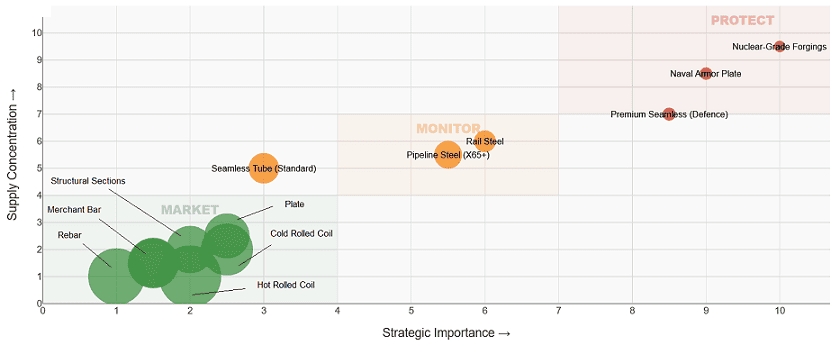
The visual paradox is striking: the smallest bubbles occupy the most critical strategic positions, whilst the largest bubbles – representing the vast majority of steel production – cluster in zones requiring no government intervention. This chart alone exposes the folly of blanket steel protection policies.
Supply Chain Concentration | Where Vulnerabilities Actually Exist
Genuine strategic vulnerabilities arise from supply concentration rather than dependence on imports per se. The US imports approximately 20–25% of steel consumption, but this dependence creates no strategic risk when imports come from highly distributed global markets with dozens of qualified suppliers. This contrasts sharply with critical raw materials like rare earths, where genuine supply concentration creates strategic vulnerabilities.
Nuclear Forging Bottleneck: Genuine Single-Point Failure
Japan Steel Works' unique position as the sole producer of seamless reactor pressure vessels represents the clearest strategic vulnerability in global steel supply chains. Loss of this capability – through natural disaster, facility failure or geopolitical disruption – would constrain global nuclear plant construction for years.
The UK government's acquisition of Sheffield Forgemasters and planned investment in forging capability explicitly recognises this vulnerability. France's Framatome Le Creusot represents a second source of supply. China's growing capability provides additional redundancy but introduces geopolitical complexity for Western nuclear programmes.
Armour Plate: Moderate Concentration with Mitigation Strategies
Naval armour plate production is spread among fewer than 10 qualified producers globally, creating moderate supply chain risk. However, geographic distribution across allied nations (US, Europe, Japan, potentially UK) provides natural redundancy. China's substantial armour capability introduces complexity but does not create Western dependence.
NATO coordination could ensure collective self-sufficiency without requiring each member to maintain independent capacity. Strategic stockpiles covering 12–18 months of requirements provide additional mitigation at modest cost.
Premium Seamless Tube: Manageable Concentration
Premium seamless tube has fewer producers than basic steel products, but around 50 qualified companies worldwide can supply it. This means there's plenty of backup if one supplier has problems. Major suppliers like Vallourec, Tenaris and TMK regularly compete for defence contracts.
Russian TMK's role creates specific vulnerability under current sanction regimes, but substantial non-Russian capacity exists. The concentration risk is real but manageable through diversified sourcing and strategic inventory.
Commodity Products: No Meaningful Concentration
HRC, rebar, standard structural sections and coated products exhibit no meaningful supply concentration. Claims that import dependence creates strategic vulnerability in these products confuse economic preference for domestic production with genuine national security requirements. The global overcapacity problem in commodity steel products demonstrates the impossibility of genuine supply concentration in these markets.
Case Studies | When Strategic Designation Succeeds or Fails
Success: UK Acquisition of Sheffield Forgemasters
The UK government's 2021 acquisition of Sheffield Forgemasters represents appropriate strategic intervention. Nuclear forging capability is genuinely strategic, supply concentration is severe and private markets were failing to provide necessary capital investment. Government ownership enables long-term capability maintenance justified by national security rather than short-term returns.
Planned investment in a 13,000-tonne forging line addresses a genuine capability gap. The intervention is surgical – targeting specific bottleneck capability rather than attempting to preserve uncompetitive general steelmaking.
Failure: Scunthorpe – When "Strategic" Claims Fail Objective Assessment
British Steel's Scunthorpe integrated works (closed 2024) was repeatedly described as "strategically important" by politicians justifying over £500m in subsidies and loan guarantees. The facility employed approximately 3,000 workers directly and supported an estimated 5,000 indirect jobs, creating intense political pressure to preserve operations. However, objective assessment against the strategic steel criteria reveals zero genuine strategic capabilities.
What Scunthorpe Actually Produced:
- Hot rolled coil for automotive and construction – commodity product available from 1000+ global facilities
- Heavy plate (until 2016 closure) for North Sea oil platforms – commercially important but not defence-critical
- Cold rolled and coated products – standard specifications with no defence applications
- Structural sections – commodity carbon steel
- Semi-finished products (blooms, billets, slabs) – feedstock for downstream processing at other facilities
Important Clarification on Rail Steel: British Steel's rail manufacturing operations are located at Hayange, France, not Scunthorpe. Scunthorpe supplied semi-finished steel (blooms, billets) that could be rolled into rail products at specialised facilities elsewhere, but possessed no rail rolling mill itself. The medium-strategic rail production capability remained at Hayange, which continued operating under Jingye ownership. Scunthorpe's closure did not affect UK/British Steel access to rail manufacturing capability.
What Scunthorpe Did NOT Have:
- No nuclear-grade forging capability (no large ingot casting, no heavy forging presses)
- No naval armour plate production (plate mill lacked MIL-SPEC qualification)
- No premium seamless tube capability (no piercing mills)
- No specialised alloy steel metallurgy beyond standard integrated mill operations
Strategic Reality: Everything Scunthorpe produced was available from dozens of European suppliers within the UK's allied trading bloc. Germany, France, Netherlands, Belgium and Sweden all possess equivalent or superior capabilities in HRC, plate and structural products. The facility's closure created zero defence supply chain vulnerabilities. Analysis of Scunthorpe's strategic repositioning challenges reveals why integrated commodity production became economically unsustainable.
The £500m+ in government support represented economic subsidy to preserve jobs. The "strategic" designation was political convenience, not underpinned by any sort of rigorous assessment.
Contrast with Sheffield Forgemasters: In the same period, the UK government acquired Sheffield Forgemasters for £2.56m plus planned investment in forging capability. This facility possesses ASME N-stamp accreditation for nuclear components, supplies defence contractors with specialised castings and forgings, and represents genuine bottleneck capability with fewer than 10 comparable facilities globally. This acquisition exemplifies appropriate strategic intervention.
The Policy Lesson: Scunthorpe demonstrates how "strategic steel" rhetoric serves protectionist agendas. A 3-million-tonne integrated mill producing commodity products was labelled strategic whilst the small-but-genuine strategic asset (Sheffield Forgemasters) received far less political attention until near-collapse. Honest policy requires economic subsidy decisions (preserving jobs, aiding regional development) to be distinguished from genuine protection of strategic steelmaking production capability.
Failure: Liberty Speciality Steel – Strategic Assets in Wrong Hands
Whilst the UK government debated subsidising commodity production at Scunthorpe, genuinely strategic steel assets deteriorated under problematic ownership with minimal government intervention until crisis point. Liberty Steel's 2017 acquisition of Tata Steel's Specialty Steels division for £100m represents a cautionary tale of strategic capability erosion through financial engineering and management failure.
What Liberty Speciality Steel Actually Represents (Strategic Assets):
- Stocksbridge, South Yorkshire: Aerospace-grade alloy steels for fighter jets, helicopters, commercial aircraft – supplies Boeing, Airbus, Rolls-Royce
- Rotherham: Engineering steels, speciality bars for high-performance automotive and defence applications
- Brinsworth and Wednesbury: Speciality steel processing and finishing
- Qualified defence supplier: Approved supplier to UK defence contractors with stringent material specifications
- Specialised alloy metallurgy: High-nickel alloys, precipitation-hardening stainless, speciality grades NOT available from commodity producers
Why These Assets are Genuinely Strategic:
- Supply concentration: Limited UK-based aerospace alloy producers, supply chain security for domestic aerospace/defence
- Defence criticality: Qualified suppliers with decades of metallurgical expertise and customer approvals
- Specialised capabilities: Alloy steel metallurgy requiring equipment, knowledge and qualification processes not easily replicated
- No ready substitutes: Aerospace specifications demand specific alloy grades with established supply chains
Post-Acquisition Deterioration (2017–2025):
Following Sanjeev Gupta's acquisition, Liberty Speciality Steel operated under the broader GFG Alliance structure financed substantially through Greensill Capital's supply chain finance mechanisms. The March 2021 collapse of Greensill Capital exposed fundamental business model weaknesses:
- Chronic underfunding: Raw material shortages, supplier payment delays, inability to maintain normal operations
- Production collapse: Some facilities operating at 1% capacity by 2025, workers describe mills as "basically derelict"
- Workforce demoralisation: Team leaders report workers "sweeping floors" with slashed hours due to lack of orders and materials
- Financial opacity: Delayed financial reporting, opaque inter-company transactions, MP accusations of a "potential Ponzi scheme"
- November 2024 restructuring: Liberty Speciality Steel UK entered restructuring to address "significant debt load" whilst promising no job losses amongst 1,500 employees
- Serious Fraud Office investigation: As of February 2025, investigating "suspected fraud, fraudulent trading and money laundering" in GFG Alliance operations
The Strategic Capability Loss:
Unlike Scunthorpe (commodity HRC with multiple alternative suppliers), Liberty Speciality Steel's deterioration represents genuine erosion of UK strategic industrial capability. Aerospace and defence customers requiring UK-based speciality alloy suppliers face reduced domestic options. Re-establishing aerospace-grade alloy steel qualification, customer approvals and metallurgical expertise requires years and substantial investment – capabilities that cannot be quickly reconstituted if permanently lost.
Government Response Contrast:
| Asset | Strategic Value | Government Support | Outcome |
|---|---|---|---|
| Scunthorpe | None (commodity) | £500m+ subsidies/loans | Closed 2024 |
| Liberty Speciality Steel | High (aerospace alloys) | Minimal until crisis | Deteriorating, restructuring |
| Sheffield Forgemasters | High (nuclear) | £2.56m acquisition, investment | Secured, expanding |
Source: SteelOnTheNet analysis. Data as of December 2025.
The Policy Failure: The UK government's approach reveals confused strategic priorities. Massive resources flowed to non-strategic Scunthorpe commodity production whilst genuinely strategic speciality steel capabilities deteriorated under problematic ownership. Only Sheffield Forgemasters received appropriate strategic intervention through government acquisition.
What Should Have Happened: When Tata Steel divested speciality steels in 2017, government should have applied rigorous strategic assessment:
- Strategic value recognition: Aerospace alloys, defence-qualified suppliers = genuine strategic assets
- Buyer vetting: Ensure acquirer has sustainable business model, not opaque financial engineering
- Golden share or conditions: Government oversight to prevent capability degradation
- Alternative: Direct acquisition similar to Sheffield Forgemasters if private sector buyers inadequate
Lessons for Strategic Steel Policy:
- Strategic assessment must precede crisis: Identify truly strategic assets before deterioration, not after
- Alloy steel capabilities matter: Speciality steels with aerospace/defence applications warrant protection; commodity steel does not
- Financial engineering destroys capability: Opaque financing models incompatible with long-term strategic asset stewardship
- Misallocated resources: £500m for commodity Scunthorpe vs. minimal intervention for strategic speciality steels until restructuring
- Reconstitution difficulty: Aerospace qualifications, customer approvals and metallurgical expertise require years to rebuild if lost
Current Status and Implications: As of late 2024, Liberty Speciality Steel remains in restructuring with an uncertain future. If these capabilities are permanently lost, the UK loses domestic aerospace-grade alloy steel production – a genuine strategic vulnerability given defence and aerospace industry requirements. This stands in stark contrast to Scunthorpe's closure, which created zero strategic gaps as all commodity products remain available from multiple allied European suppliers.
Strategic Implications
For Steel Producers
Companies with genuine strategic capabilities (armour production, nuclear forgings, premium seamless tube) should emphasise these distinctive competencies rather than seeking protection for commodity operations. Strategic designation provides pricing power and insulation from foreign competition – but only if maintained through rigorous assessment rather than political lobbying.
Commodity producers claiming "strategic" status risk backlash when economic costs become apparent. The industry's credibility suffers when armour plate producers are treated the same way as rebar mills, undermining legitimate strategic cases.
For Governments
Rigorous application of strategic material criteria is essential to prevent protectionism disguised as security policy. Four questions discipline assessment:
1. Is supply genuinely concentrated amongst fewer than 10 producers?
2. Does defence consumption exceed 10% of total demand for this product?
3. Are production lead times greater than 12 months?
4. Do viable substitutes exist?
Products failing three or more tests should not receive strategic designation regardless of political pressure. Protecting commodity carbon steel production provides no strategic benefit whilst imposing substantial economic costs2.
For Investors and Acquirers
Steel companies with genuine strategic capabilities command premium valuations justified by pricing power and political insulation. CMC Impact Metals' armour plate capability, Japan Steel Works' nuclear forging monopoly and premium seamless producers' defence relationships create sustainable competitive advantages. The pattern of steel industry consolidation demonstrates how strategic capabilities drive acquisition premiums, with speciality steel assets commanding valuations far exceeding commodity producers.
Conversely, commodity producers dependent on protectionist tariffs for profitability represent value traps. Investment proposals based on "strategic" designation for HRC or rebar production are without foundation.
The Metallurgical Divide | Strategic = Alloy Steel
A defining pattern emerges from this analysis: genuinely strategic steel products are predominantly alloy steels requiring specialised metallurgical capabilities, whilst commodity products claiming strategic status are plain carbon steels produced by standard processes. This metallurgical distinction explains supply concentration, lack of substitutes and defence criticality.
Naval armour plate demands nickel-chromium-molybdenum alloy systems with special hardening treatment to achieve very high hardness whilst maintaining toughness and weldability. These are capabilities possessed by fewer than 10 producers globally. Nuclear-grade forgings require manganese-molybdenum-nickel alloys with precise grain structure control and zero-defect integrity. Premium seamless tube for defence applications uses chrome-moly alloys with specialised heat treatment and piercing mill technology.
In stark contrast, hot rolled coil, rebar, galvanised sheet and standard structural sections are plain carbon steels requiring no specialised metallurgical expertise beyond basic steelmaking. Hundreds of facilities globally produce HRC. Hundreds of mills produce rebar. The metallurgical knowledge is ubiquitous; the equipment is standard; the supply base is globally distributed.
The policy implication is clear. Rather than asking "Is steel strategic?", governments should ask "Do we possess domestic capabilities in specialised alloy steel metallurgy?"
This reframing eliminates 99% of steel production from strategic consideration whilst focusing resources on genuine capabilities that are scarce, difficult to replicate and defence-critical.
Conclusion
The question "Is steel a strategic material?" has no simple yes or no answer. Approximately 1% of steel products – armour plate, nuclear-grade forgings and premium seamless tube for defence applications – merits genuine strategic consideration based on supply concentration, defence criticality and lack of substitutes. These products represent a few million tonnes of the global market of 1,742 million tonnes (2024)1.
The remaining 99% of steel products trade in deep, competitive global markets with multiple suppliers, reasonable substitutes and manageable lead times. Treating these as "strategic" imposes massive economic costs on steel-consuming industries whilst delivering minimal security benefit.
Honest policy requires product-specific analysis, transparent criteria and surgical interventions where genuine vulnerabilities exist. The alternative – blanket protection justified by national security rhetoric – represents expensive protectionism that weakens rather than strengthens national economic resilience. Recent European policy responses demonstrate both the political pressures and economic complexities of steel sector intervention.
The companies and governments that will succeed are those capable of distinguishing between alloy steel capabilities that genuinely matter for national security versus commodity carbon steel production serving protectionist agendas. This distinction is worth billions in investment decisions, M&A valuations and policy effectiveness. Strategic designation is too important to be cheapened through indiscriminate application to an entire sector. The distinction between specialised alloy steels requiring scarce expertise and ubiquitous commodity carbon steel is what should guide deliberations on steel sector protectionist policy.
SteelOnTheNet
4 December 2025

Facing this on a live project? Our Research Service → Discuss a Project →
How to Cite This Article
Kotas, A.M. (2025) 'The One Percent Rule: Separating Strategy from Rhetoric', SteelOnTheNet. Available at: https://doi.org/10.5281/zenodo.18924373 (Accessed: 26 October 2026).
Author credentials:  ORCID iD