Welded Tube Mill Costs
Tube and Pipe Cost Modelling Notes and Assumptions [Data as of mid-2025]
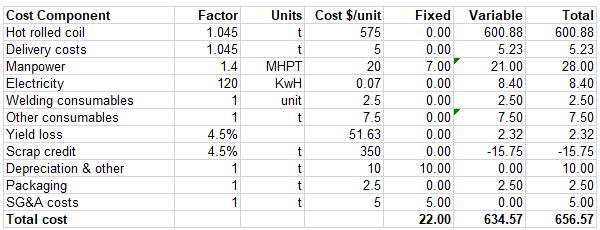
The Steel Costing ModelThe economic model shown above indicates how tube costs can be estimated through a simple cost benchmarking approach. The predicted full cost is not meant to represent an actual cost for any real steel company. It is a notional figure only – albeit one that is built on fairly representative current input cost (e.g. electricity prices) and resource usage information.
Input CostsKey input costs are based on average 2025 costs, with ferrous scrap at ~US$350 per tonne and hot rolled coil at ~US$575/t. Other factor costs e.g. electricity are from other pages shown on the SteelOnTheNet website, with factor usage (energy use, yield etc) estimated by our technical experts and economists. SG&A denotes sales, general and administration cost. MHPT denotes man hours per tonne (a measure of labour force productivity). Analysis shown above was prepared in mid-2025.
The Steel ProductThe steel product for which costs are shown is a tonne of welded tube 50 mm × 50 mm square with a gauge of 2.5 mm and made from commercial quality steel [e.g. grade S235] as produced by an average-sized non-integrated tubemaker who purchases hot rolled strip on the open market. Average labour productivity is assumed, in a Central European location.
Additional costs ['price extras'] for internal or external painting or galvanising, annealing, NDT or other testing, threading etc of tubing are excluded. Note that although an HRC delivery cost of US$5 per tonne is included above, this cost could be considerably higher depending on plant location. Similarly, packaging costs could also be much higher than shown, depending on client geography and requirements.
The Business EnvironmentSite visitors are advised that all estimates shown should be adjusted to reflect the particular business environment in which the steel plant operates. Thus, electricity charges may be substantially higher during the winter season, etc. Depreciation costs above are at the low end of the range, and may be higher depending on the mill supplier. Yield performance is also average – and certainly nowhere near best practice.
Accounting MethodsActual cost estimates may differ because of local accounting practices. The estimates above assume that 25% of labour costs are fixed – different local assumption may apply. The model above endeavours to present the economic data on the basis of standard management accounting practices – users of the model should however be clear that the model is likely to require adaptation for different accounting circumstances.
Raw Material & Other Cost AdjustmentsTo estimate the impact of a change in any main input (e.g. location, hot rolled steel coil cost, energy cost or labour cost) on the total, fixed or variable production costs of any steel product (semi-finished; or flat, long, or pipe and tube finished steel) made through either main production process route (integrated steel manufacturing or electric arc steelmaking), please contact our steel cost economists at info@steelonthenet.com.
Need costs for your own plant or location? Request a custom cost model →
How to Cite This Page
SteelOnTheNet 'Welded Tube Cost Model: Pipemaking Production Economics', SteelOnTheNet. Available at: https://www.steelonthenet.com/resources/cost-models/welded-tube.html (Accessed: 26 October 2026).
Related Content