Automotive Galvanising
Published:
This technical module explains the fundamental differences between commodity and specialty steel products, and outlines what is involved in manufacturing and marketing advanced materials — which goes far beyond installing the required plant equipment. The focus is automotive galvanised steel, which provides an excellent specialty product case study, but the same principles apply to other specialty products. It also asks whether an existing commodity producer can realistically make the leap — and concludes that, for most, it means a new line, audited substrate and probably a joint venture partner. It forms part of a series of technical reference modules authored by Steven W. Hesling.
The content is based on the author’s experience throughout North America, and with ThyssenKrupp and Voestalpine in Europe. Practice in Japan is likely to be similar. Elsewhere, standards may differ — India, for example, appears to have quite different requirements for automotive steel.
1. What Distinguishes Commodity and Specialty Products
Until about 1995, most steel mill output was commodity products. These are still made in large quantities, but the proportion of specialty products continues to grow.
Galvanising follows the same pattern. Simple products for common, basic applications were, and continue to be, made using relatively inexpensive equipment — and new lines for manufacturing such “commodity” products are still being built.
Automotive materials are much more technically advanced, and are a near perfect example of “specialty” products. The first lines built specifically to manufacture them came in the early 1990s, and the number in use has increased progressively since.
Note that automotive-capable lines can make commodity products — and actually require some in their mix. For example, commodity products are made while an automotive line is stabilising its process after an extended shutdown.
Commodity Products
Commodity products include wheat, steel reinforcing bars and regular unleaded petrol. This seemingly unlikely grouping shares the following characteristics:
- Minimal differentiation. Identical product is used by many customers, and industry standard specifications prevail.
- Markets are large, with many sellers and buyers.
- With multiple suppliers competing mostly on price, margins are thin.
- There is little if any customer loyalty — “dumping” by foreign manufacturers is possible.
- Manufacturing focus is cost reduction. (Commodity products do not change or develop much.)
- Service centre type operations may stockpile and distribute to smaller consumers who do not meet volume requirements for direct supply from manufacturers.
Products which qualify as “commodity” normally meet all of the above criteria.
Specialty Products
Specialty products are also sometimes called added value products. Normally they are premium and/or customised in some way. For example, automotive exposed body panels have extremely high surface quality requirements, together with specific dimensions and coatings as required by individual customers.
Characteristics of specialty products include:
- High prices: customers willingly pay more for specific features, properties and quality. (This cost is usually recoverable.)
- Differentiation: products are made to meet the requirements of individual customers. For example, vehicle manufacturers have their own (similar) coating specifications.
- Continuing product development: automotive structural materials are a good example.
- On-time delivery is essential: alternate supply is often not available. When products go into complex assemblies such as vehicles, lack of a single component can halt production.
- Smaller individual orders: major customers often order small quantities of many products.
- Extended qualification process: up to two years for automotive. This is costly, and requires substantial time and effort from both producers and customers. Customer relationships matter — automotive customers want individual suppliers to provide the greatest possible range of products.
- Patents and proprietary restrictions: may be an issue.
- Key requirements: suppliers need specific equipment, technical know-how including R&D, process control, inspection and testing, and business systems including product costing.
- Manufacturing focus: process control, quality management and product innovation.
A product may qualify as “specialty” while meeting only some of the above criteria. The following case study is a real example of a commodity manufacturer inadvertently tripping over this borderline.
A hot rolled plate mill defined its minimum and maximum thickness, width and length. It could roll any size within these ranges, but in practice made only a limited number of “standard” dimensions for commodity customers. Few slab sizes were required, and slab inventory was therefore kept low. For example, one slab might be rolled and sheared to produce:
- 4 pieces of 240 inches length × 0.25 inch thickness
- 2 pieces of 240 inches length × 0.50 inch thickness
- 1 piece of 240 inches length × 1.00 inch thickness
When a wind turbine tower company started using plate nearby, this appeared to be a good market. But wind towers vary in diameter — larger at the base and smaller at the nacelle — so multiple plate lengths are needed to make the hoops and cones which form the tower. Variations in bending moment also require a range of calculated plate thicknesses, which change with location in the tower.
A large number of specific plate thickness and length dimensions were therefore required, and to avoid excessive end trim yield losses, multiple different slab dimensions were needed for these. Total slab inventory grew, and yield still decreased somewhat.
Wind tower manufacture also requires product “packets” containing all the plates needed to make a tower. Just one missing piece prevents completion, so 100% delivery performance became critical.
The author has personally witnessed several such cases, where commodity product mills accepted business which was in some way specialty — without thinking sufficiently about the issues this could create.
2. Automotive Product Types and Characteristics
In this module, “automotive” refers to flat rolled and coated steel used in the structure and exposed body panels of passenger cars and light vehicles. It excludes steel used in suspension components, springs, drive shaft tubing and similar parts.
Two consistent themes have driven automotive product development over recent decades: safety and fuel efficiency.
Fuel Efficiency and the CAFE Standard
Fuel efficiency increases have been mandated by legislation such as the North American Corporate Average Fuel Economy (CAFE) standard. There is a defined relationship between vehicle weight and fuel used, and improved steel properties make possible weight reductions which can substantially decrease fuel consumption. (A similar relationship is expected for electric vehicles.)
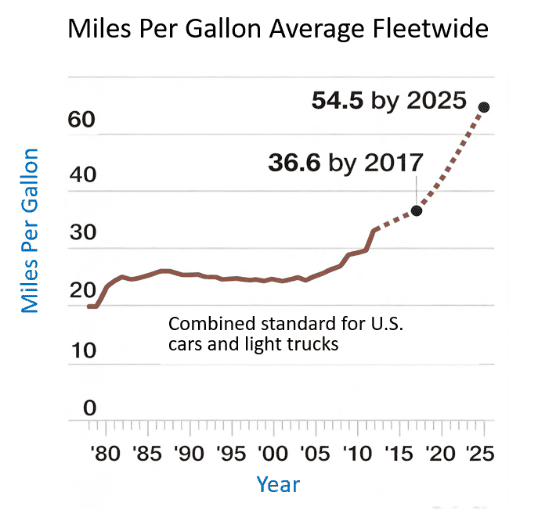
In 2012 the Obama administration targeted a North American fleet average of 54.5 mpg by 2025 (a projected 163 grams of carbon dioxide per mile). This very challenging objective initiated aggressive automotive steel development programmes. However, repeated relaxations of CAFE requirements under subsequent administrations reduced the priority given to weight reduction.
Safety
Safety requires controlling deceleration and absorbing energy in an impact. Energy equals force times distance, so structural materials need to be both strong and ductile. Their development is ongoing: current third generation Advanced High Strength Steel (AHSS) grades, including Quench & Partition, require complex thermal treatments in large and appropriately designed galvanising furnaces.
Safety also requires the passenger cabin to be surrounded by a very strong frame which prevents intrusion. A common and successful material for this frame is Press Hardening Steel (PHS), described further below.
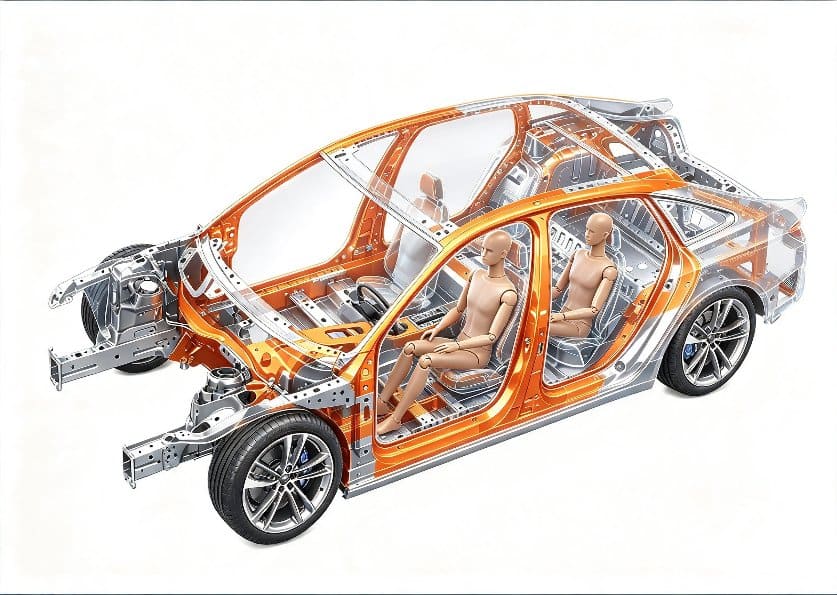
“Automotive” is not a single product, or even a single family of products. There are three main categories of steel application in vehicles, with very different requirements and characteristics — and within each category, multiple materials are used.
1. Exposed Body Panels
These are non-structural; their purpose is aesthetic, and to exclude rain and dirt.
Interstitial Free (IF) steel is used to make horizontal exposed panels, including the roof and hood. These components are viewed frequently and at low angles, and therefore require exceptionally high surface quality. IF steel is soft, with excellent formability. (Flatness is less important in this application.)
Bake Hard (BH) steel is used for vertical exposed panels, including doors and fenders. BH trades some surface quality for higher strength, to resist “car park shopping trolley” type dents. Strength is achieved by leaving some carbon in solution in the steel. This diffuses and pins dislocations during paint oven curing, increasing strength by about 45 MPa — hence the term “bake hardening”.
Over many years these materials changed relatively little. But there is now interest in higher strength steels, including Dual Phase (ferrite/martensite) materials, for vertical exposed applications. These have much higher strength levels, potentially further improving dent resistance and allowing vehicle weight reduction through decreased thickness.
2. Structural Components
Cars have a strong and rigid welded structure to which the suspension, engine and transmission, external body panels and so on are attached. As described above, this structure must also control deceleration and absorb energy during an impact, so it requires steel which is both as strong and as ductile as possible. Weldability is also crucial.
Since about 2000, there has been ongoing development of steel grades for vehicle structures, with third generation AHSS grades the current benchmark.
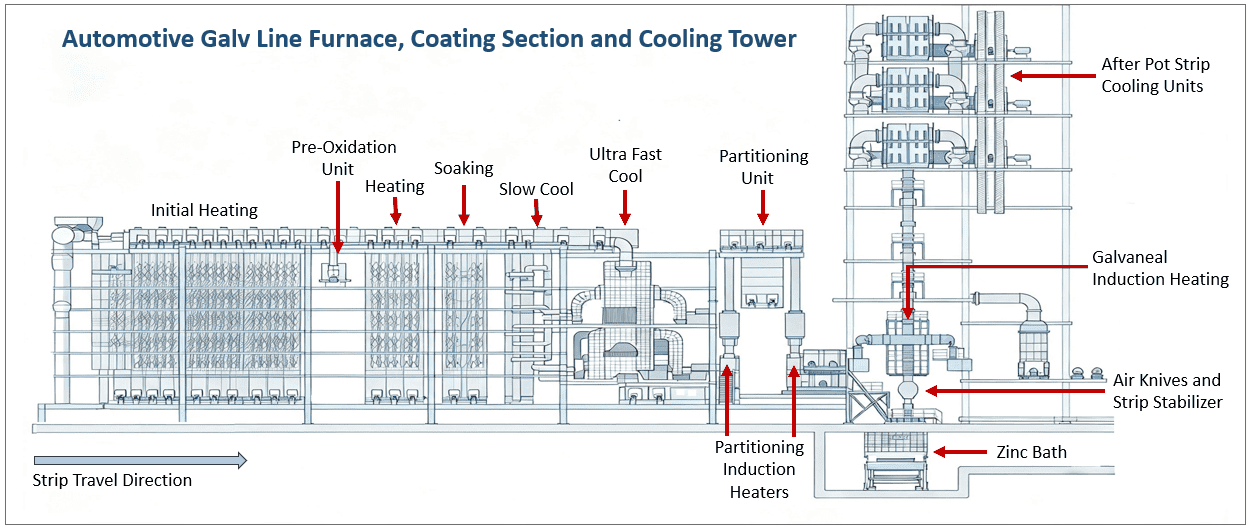
These developments have driven major changes in galvanising line furnace design. Historically, commodity product furnaces were horizontal, but automotive line furnaces now have many vertical spans of 20 metres or more — achieving long effective lengths within reasonable floorspace. These furnaces also make complex thermal cycles possible, and include very powerful and effective “jet cool” units, which can now deliver cooling rates of up to about 200 °C/s with 1.0 mm thick strip.
Third generation grades such as Quench and Partition need additional furnace sections — for example, a low temperature soak followed by induction reheating before the zinc bath. Furnace design decisions for a new line must therefore take into account the entire potential product mix, and the anticipated thermal cycle requirements of probable next generation materials.
Alloying elements such as manganese and silicon are present in substantial quantities in structural grades. These unavoidably form oxides in the furnace, which are not wetted by liquid zinc and result in coating defects. Oxide morphology and location must therefore be controlled — specifically, the aim is for oxides to exist within the strip, not exposed on its surface. This may be achieved by an oxidation chamber inside the furnace, correct setup of a direct fired pre-heat unit, or even by injecting water directly into the furnace.
This is very different from the “avoid oxidation as much as possible” strategy used in commodity product lines. If operators and other personnel are brought from commodity product lines to operate a new automotive line, they must be educated and supervised to follow procedures contrary to what they have practised throughout their careers.
3. Safety Frame
The safety frame surrounds the passenger compartment and resists intrusion in case of an accident. High ductility is not required — mostly the safety frame just needs to be very strong, which can be achieved by fast cooling a relatively simple carbon/manganese steel.
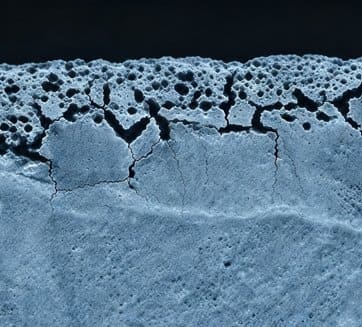
One good option is Press Hardening Steel, where blanks are heated to about 900–950 °C and then formed in water cooled dies. Zinc evaporates at these temperatures, so a Type 1 aluminium coating is used — and few lines are capable of applying it. (Alternative coatings are being developed, and patents for this process exist and are enforced.) Fast cooling in galvanising and continuous annealing furnaces can also achieve the required strength, but gives excessive and variable “spring back” during press forming.
The “Banana Diagram”
The well recognised name of this diagram comes from its general shape. Figure 4 is an example, showing mechanical property ranges for some automotive grades. (It is simplified and does not include all materials, to provide a more understandable introduction to the concept.)
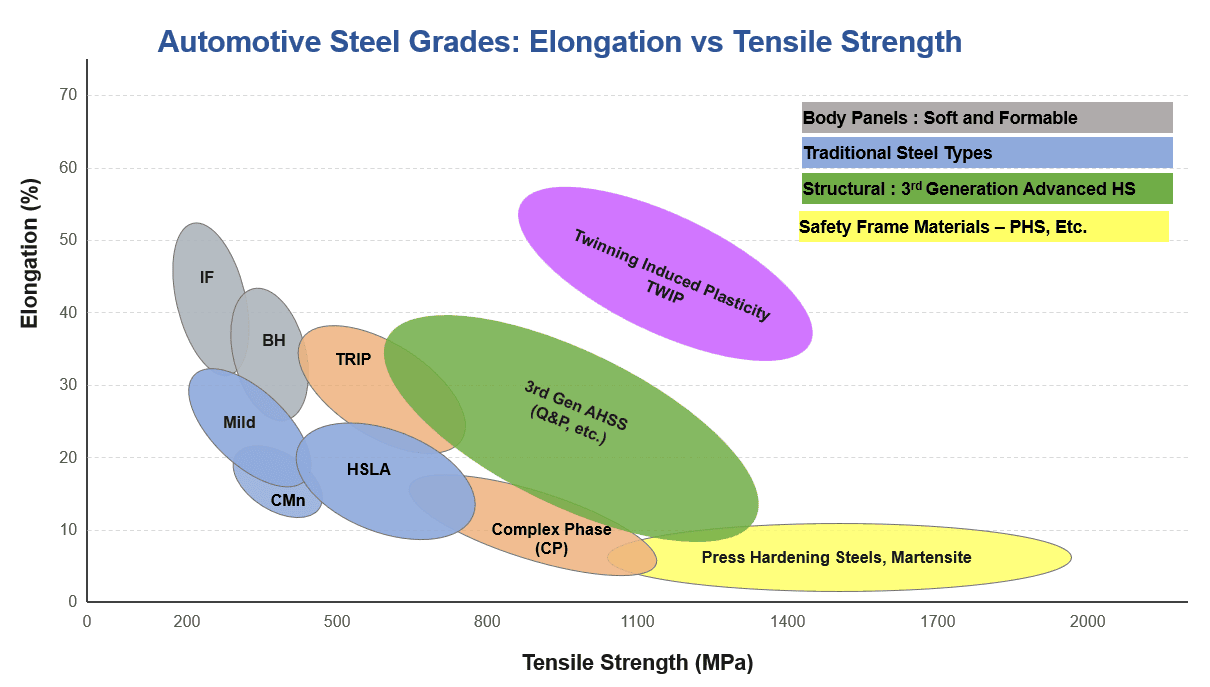
Note that the traditional materials — mild steel, carbon manganese steel and HSLA — are the only ones normally made in commodity product lines. Seeing how these commodity materials now cluster in one corner of the diagram emphasises how far automotive materials development has progressed.
Twinning Induced Plasticity (TWIP) grades, containing up to about 17% manganese, are still under development but already have some limited commercial application.
3. Manufacturing Equipment
Commodity Galvanising Lines
A commodity products galvanising line typically has a capacity of between 250 and 300 thousand tons per year. Maximum width is usually about 1,550 mm, and the thickness range is typically 0.40 to 2.0 mm. The horizontal furnace is only capable of a simple recrystallising anneal, or a lower temperature “full hard” cycle in which the structure does not recrystallise. Grades are mostly simple carbon steels, and coating weights and coating standards are not challenging.
Cold rolled coils for this line can be supplied by a single reversing cold mill downstream of a small pickle line. With a paint line perhaps added as well, this can form a sensible business unit serving a geographical area. Hot rolled coils supplied to the pickle line are widely available from various sources, and can be stored outside without significant deterioration.
Automotive Galvanising Lines
With automotive, this picture changes completely:
- Slab and hot rolled coil must come from upstream plants that vehicle manufacturers can audit — in practice, normally plants affiliated with the galvanising line. Vehicle manufacturers audit entire supply chains, so spot market purchases of slab and/or hot rolled coil are not accepted.
- Vehicle manufacturers want a single supplier to provide most of their wide range of products. An extended qualification process commits both parties to this arrangement on a long term basis.
- Reversing cold rolling mills are not suitable for automotive. “Stand-alone” tandem cold mills fare better but are not ideal, especially for exposed product, because they must be threaded and unthreaded with every coil — and defects are associated with this process. The best option for automotive exposed is a coupled pickle line / tandem cold mill (PLTCM), in which processing is continuous and stable, with better yield. PLTCMs have capacities of between one and two million tpy.
- An automotive galvanising line has a capacity of about 450,000 tpy, so at least two automotive galvanising lines are required to consume a realistic PLTCM output. (ArcelorMittal at Calvert, Alabama supplies four large lines from a single PLTCM.) When two automotive galvanising lines are built together, it is common for them to have different specifications based on product focus — for example, one line may be designated as the primary producer of exposed body panel materials.
Maximum automotive product width is about 1,850 mm in North America, driven mainly by vehicle dimensions and the size of the horizontal exposed IF grade panels used in them. All equipment in the manufacturing stream must be sized accordingly.
Most of the critical technology for automotive structural materials is associated with the furnace and the thermal cycles it is designed to deliver. Advanced mechanical property evaluation equipment is also required. Critical manufacturing issues for exposed body panels focus mostly on the zinc bath and subsequent coating-related equipment, and leading edge inspection technologies are also essential.
Hot Rolling Mill Configurations: A Moving Target
Automotive products have traditionally been made on conventional hot strip mills (HSM), which reheat and roll slabs of about 200 mm thickness — Ternium started a new HSM of this type in Mexico in 2021. Compact Strip Production (CSP), which rolls slabs of about 50 mm thickness directly from the caster, saves fuel and rolling energy, and is now making some automotive materials.
The CSP route will likely prevail in the longer term, but the author recommends caution today. Its ability to make exposed quality and some structural grades reliably on a commercial scale is not yet well established. And its long runs of similar chemistries suit commodity products far better than automotive order books, with their many diverse chemistries, small lots and demanding delivery. A conventional HSM, by comparison, can pull a few slabs from its yard to complete an urgent order in perhaps one day.
4. Process and Manufacturing Technology Examples
Coating Mass Standards
Commodity galvanised products in North America are mostly made to old ASTM standards based on average coating weight in a coil, with no maximum limit. Car companies instead specify a minimum coating mass at every location in the coil — which correlates much better with product life — together with a maximum, because heavy coatings shorten welding electrode life. Meeting these automotive coating specifications requires a coating weight control system which operates in a different mode from that used for the ASTM commodity product specification. Automotive also requires a record of whether every part of each coil has too little, sufficient or too much coating. (See Air Knife & Coating Mass Control.)
Coating Types
Most commodity product, and most North American automotive product, is zinc coated (GI) with about 0.25% aluminium in the bath. Some — predominantly Japanese — vehicle manufacturers require galvanneal (GA), in which the strip is reheated directly after the bath to form zinc-iron alloys. GA needs a lower bath aluminium level, an induction reheat unit and careful control, and generates more difficult bottom dross; automotive lines therefore often have two zinc baths on rails, one for each chemistry. Zn/Al/Mg coatings, which give better corrosion resistance at a lower coating thickness, have made substantial inroads in Europe but are offered by only one North American producer. (See Dross Control in Zinc Galvanising Lines.)
Achieving Automotive Exposed Surface Quality
Horizontal exposed IF panels need a moderately high furnace temperature, but not a complicated thermal cycle. The difficulties lie elsewhere: controlling dross pickup from the bath and build-up on transport rolls, well controlled temper rolling with EDT textured rolls, and careful two-side inspection using vision systems and abrasive stones. Held material is dispositioned by a technical team rather than the line inspector — and with little downgrade market for exposed product, the choice is often prime or scrap. (See Temper Rolling & Tension Levelling.)
5. Automotive Implementation Overview
Scale of Capital Investment
An automotive galvanising line built on a greenfield site will probably cost in the order of 250 to 350 million dollars. The actual number will vary depending on parameters such as whether galvanneal coating capability is required. (Galvanneal normally requires multiple interchangeable coating metal baths, and an induction reheat furnace installed directly above the air knives.)
Savings per line may be achieved if two lines are installed together. For example, they may be located in a single building with a single set of longer span cranes. Effluent treatment, zinc handling and storage, maintenance and so on may then be centralised, and overall manpower reduced.
The capital cost of two automotive lines can be further reduced if they are designed for different product mixes. For example, it may be sufficient for only one of the two lines to have a furnace containing the (expensive) equipment required to make Quench and Partition grades.
Two galvanising lines also fit within the minimum realistic capacity of a PLTCM for converting hot rolled coils into cold rolled for galvanising. These have a capital cost of about 350 to 450 million dollars, and a minimum output of about one million tons per year.
Substrate supply, discussed in Section 3, adds a further challenge: the capital cost of installing primary steelmaking, casting and hot rolling runs into billions of dollars. In principle, one alternative is a long term purchase agreement with a respected steelmaker which agrees to accept — or has already accepted — a third party automotive audit. Section 6 considers how this works in practice.
Qualification Process
Automotive galvanising lines have an extended qualification period which, even if everything goes reasonably well, lasts up to two years. Much of this is procedural, but serious development challenges do exist, mostly involving exposed and advanced high strength materials development.
Qualification focuses on manufacturing progressively more demanding products, in increasing quantities, with evaluation and feedback from the customer at each step.
In addition, all aspects of manufacturing and quality management are audited during extensive site visits by the customer’s audit team. These include interviewing operators, to confirm their knowledge and their ability to access all operating procedures and quality-related documentation.
This process is repeated by multiple customers — although if a demanding customer such as Toyota is satisfied, a good framework is in place for the others. Some companies also have reciprocal arrangements: for example, BMW and Mercedes each accept an audit pass by the other.
In the author’s own experience, initial product samples started being sent to automotive customers approximately four months after the first coil was produced on the line, and limited quantities of exposed product were being evaluated by customers after about twelve months. Note that some customers requested automotive exposed quality coatings on non-exposed parts, and used this as a safe way to track coating improvement progress.
Automotive exposed is made in once-per-month campaigns, shortly after a shutdown during which zinc bath rolls are changed. One month is therefore one development cycle.
During qualification, the line fills its remaining capacity with whatever commercial/commodity product orders it can obtain. Its high cost structure compared to normal commodity product lines makes this business marginally economic at best. (Even after qualification is complete, a limited amount of non-automotive material continues to be made, mostly to stabilise the process after shutdowns.)
If all goes reasonably well with automotive qualification, EBITDA for the line might be expected to reach break-even about two years from start-up.
Organisational Requirements
Organisational and systems requirements for automotive lines are extensive. These are driven by the following:
- Virtually every material used by each customer is a different product. Product definitions have to be available for each, along with key items of information — product cost is one example.
- Process control and quality management are essential. This requires multiple specialists in different roles, together with evaluation tools and monitoring and reporting systems.
- Product and manufacturing technology continue to improve. Process capability development is needed to support product improvements and more efficient manufacturing, and the need for a research and development group to support this is generally recognised. Japanese and some other manufacturers also have “operations technology” groups, which have an implementation and improvement focus and are integrated close to the line.
- Customer relations matter greatly. Sales, management, technical groups and even maintenance need to understand both their own and the customers’ processes, to participate actively together in resolving issues.
Automotive Line Issues and Solutions
The majority of issues in automotive galvanising lines are associated with a lack of technical knowledge and support from experienced manufacturers, at various stages from initial planning through to product qualification.
In North America, one common answer to this involves a joint venture with an experienced manufacturer which already has established relationships with key customers. For example:
- Ternium and Nippon Steel have an automotive exposed joint venture line in Pesquería, Mexico.
- Nucor and JFE have a 50/50 joint venture automotive line in Silao, Mexico. (This line reportedly cost $270 million — within the range indicated above.)
- ArcelorMittal and Nippon Steel ran the Calvert, Alabama plant as a 50/50 joint venture from early 2014 to mid-2025.
An additional advantage of a joint venture of this kind is that it may provide a source of galvanising substrate which is already approved by automotive customers.
6. Can a Commodity Producer Make the Leap?
Upgrading a Commodity Galvanising Line
A reasonably modern and well maintained commodity line could make a limited amount of automotive product after a moderate upgrade.
Air knives and coating weight control equipment would probably need replacing, to achieve lower automotive coating weights and tighter coating specifications. The cost of this would likely be around one million dollars (author’s estimate). Inspection and product testing equipment upgrades would also be needed, together with an in-line temper mill using EDT textured rolls. (The line might already have this temper mill, if it previously supplied a paint line.)
Business systems, process information recording and storage, operating and quality procedure documents and so on would also be required — together with some additional people with appropriate abilities in sales, technical groups and other functions.
Buildings, zinc and other consumables storage, and terminal equipment such as uncoilers and recoilers, shears and the welder could all be reused.
Unfortunately, this moderate expense and effort would only enable manufacture of unexposed materials in simple steel grades, perhaps including HSLA and some Dual Phase. These make up about one third of modern vehicle structure weight (author’s estimate), though this percentage might be significantly higher in less developed countries.
It is unlikely that full automotive exposed surface quality can be made on what was previously a commodity products line. But depending on the footprint of the existing furnace, it might be possible to upgrade the furnace, significantly extending the steel grade range.
Remember also that in North America, automotive companies strongly prefer suppliers who can offer a full “product basket”. This will not be possible from a converted commodity line.
In summary, the author is not aware of any commodity products line having been converted to make automotive, and in North America doing so appears to make little sense. Elsewhere, things may be different — and individual cases merit specific review.
Substrate Supply for a Stand-Alone Galvaniser
Automotive companies want substrate to come from sources which they can audit. At ThyssenKrupp’s Calvert plant, all slabs initially came from a ThyssenKrupp-owned plant in Brazil. This was not a problem: customers flew audit teams there and verified that everything was in order.
ArcelorMittal now owns the Calvert plant, and brings in slabs from other audited ArcelorMittal locations such as Lázaro Cárdenas in Mexico.
Logically, a stand-alone galvaniser might do something similar, by signing a long term purchase agreement with a supplier which does not mind occasional audit visits from vehicle manufacturers.
In practice, the author has never seen this happen. As noted in Section 5, 50/50 joint ventures are what is actually found. Motivations for these seem to differ, and substrate supply is only one of several issues involved.
Order of Product Qualification
A newcomer starts with simple carbon steel grades for non-exposed, structural parts. (Note that all structural parts are non-exposed, and all exposed parts are non-structural.)
Progressively higher strength structural grades are then added, including HSLA and perhaps some Dual Phase. Mild steel is the easiest to make, and difficulty increases with strength level. This experimentation establishes what is possible without substantial modifications to the original commodity line furnace. (Exceptionally, the author once achieved a lower Dual Phase grade in an unmodified commodity line furnace.)
Exposed automotive coatings are currently applied almost entirely to Interstitial Free (IF) or Bake Hard (BH) steel grades. These require fairly high furnace temperatures of about 850 °C, but the thermal cycles are not especially difficult.
Most issues with exposed product involve coating defects from the zinc bath, and dents associated with build-up on transport rolls. (Exposed panels are dent sensitive due to their fairly low thickness and very low strength.) Controlling these issues would be very difficult without automotive-specific bath equipment.
The practical test for a commodity producer is therefore whether its target customers can be served with non-exposed, simpler structural grades alone. If exposed product or a full product basket is required, the leap means a new automotive line, audited substrate and probably a joint venture partner, as described in Section 5. Without these, it is unlikely to be worth attempting.
7. Summary
Commodity and automotive galvanised products may look similar, but in almost every important respect they are different. Measured against the characteristics set out in Section 1, automotive is a specialty product on every count: customer-specific specifications, continuing product development, demanding delivery, an extended qualification process and close, long term customer relationships. Meeting these requirements goes far beyond installing the right equipment. It changes how the whole organisation works — from operators and inspectors to sales, technical groups and business systems.
For a commodity producer, the leap is therefore much larger than it first appears. Token quantities of automotive product can be made on an upgraded commodity line, but only in non-exposed, simpler structural grades. Becoming an established automotive supplier requires substantial capital investment, including at least one new automotive line. It also requires substrate from upstream plants that vehicle manufacturers can audit, and up to about two years of qualification before the line can expect to break even. Because automotive structural grades continue to develop, that equipment must also be chosen with future materials in mind.
This is why recent North American success stories have mostly been joint ventures with capable, well connected partners. Automotive manufacture is definitely not the fast and easy way to make money that some people seem to think. And while this module has used automotive galvanising as its case study, the same lesson applies to other specialty products: added value comes with added cost, added work and added requirements — and the leap needs to be planned with all of them in view.
References
- National Highway Traffic Safety Administration, Corporate Average Fuel Economy (CAFE) standards: https://www.nhtsa.gov/laws-regulations/corporate-average-fuel-economy
This module draws primarily on the author's direct experience of automotive galvanising line start-up and qualification in North America and Europe.
Next Steps for Your Business
Moving from commodity into automotive or other specialty products is a major investment decision, with long qualification times and substantial organisational change. An independent review before committing capital can help you assess:
- Whether an existing line can be upgraded, or a new line is required
- Realistic capital cost, qualification timeline and route to break-even
- Substrate supply options and potential joint venture structures
- The organisational, systems and skills changes needed to serve automotive customers
If you are considering a move into specialty products, why not give us a no-obligation call? Our experts will be pleased to discuss your requirements with a view to an initial concept study.
152 projects in 48 countries since 2001
Free, confidential first conversation No obligation Reply within one working day

| Air Knife & Coating Mass Control | X-ray coating mass measurement, ASTM specifications, air knife design and setup, edge baffles and automated coating weight control. |
| Dross Control in Zinc Galvanising Lines | Top and bottom dross formation mechanisms, aluminium control, removal practice and cost reduction in the galvanising bath. |
| Strip Centring in Vertical Furnaces | Roll crown mechanics, the balance between tracking-off and heat buckle, ground crown profiles, roughness and thermal crown control in vertical furnaces. |
| Temper Rolling & Tension Levelling | Strip shape principles, tension levelling and temper rolling equipment, discontinuous elongation and surface conditioning of zinc-coated strip. |
| Coil Winding in Galvanising Lines | Radial and tangential stress in wound coils, strip compressibility, telescoping and other winding failure modes and corrective actions. |
| Plate Mill Yield and Provisioning | Provided yield and provisioning, yield cost and margin loss, plan view rolling, scale loss and hydraulic gauge control in plate mills. |
How to Cite This Article
Hesling, S.W. (2026) 'Taking the Leap From Commodity to Specialty Products, Especially Automotive', SteelOnTheNet Technical Reference Series. Available at: https://www.steelonthenet.com/resources/technical/commodity-to-specialty-automotive-galvanising.html (Accessed: 17th October 2026).